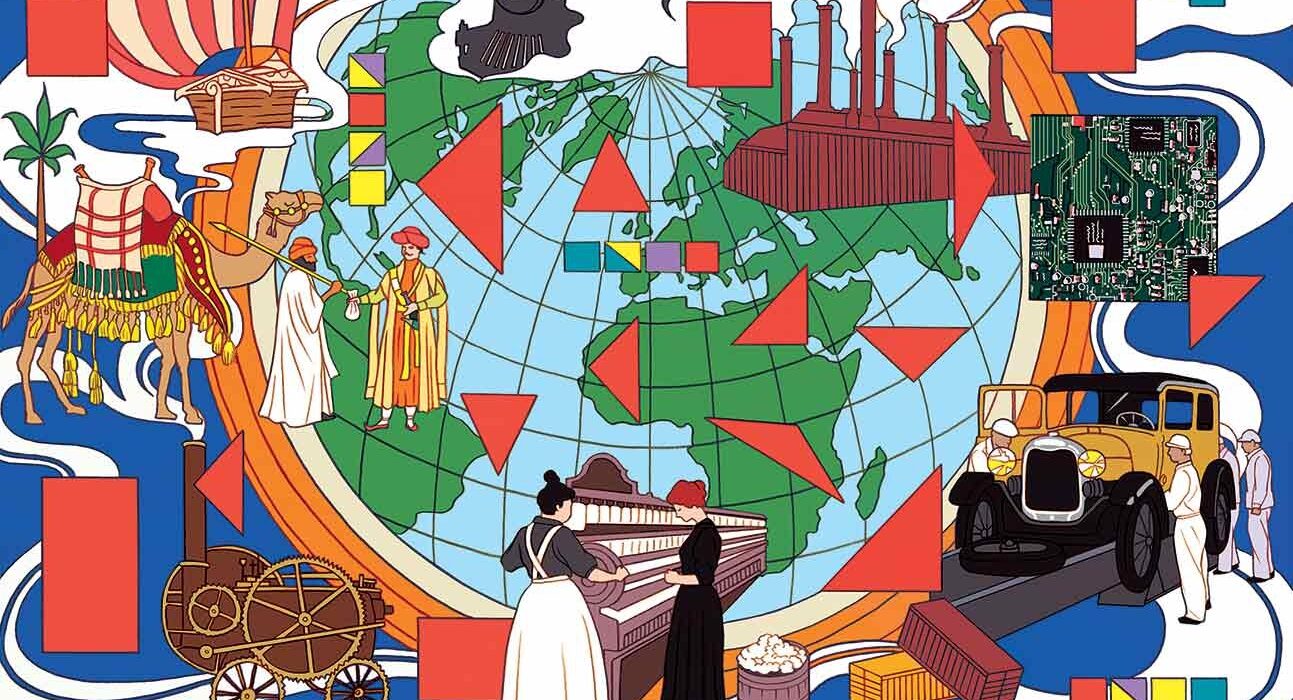
No one agrees on when, where, or how capitalism began, or whether it had a beginning at all, but everyone agrees that capitalism, the word, first appeared in the 19th century. Capital and capitalist slipped into use, unnoticed and unremarked, in the 13th and 17th centuries. Capitalism burst through the barricades of political argument in the 1830s, announcing immediately the hostility of its user. “Long live capital!” cried the French socialist Louis Blanc in 1839. “Long may we go on to attack capitalism, its mortal enemy, with even more intensity.” As much as the word named something, so did it identify its speaker—as a worker, a radical, a hater.
A 19th-century dictionary usefully notes that “ism” words are “systemative,” and a system might have been the one thing that everybody agreed capitalism was. But a system of what? The economy was hardly a concept at the time, and even if it had been, was capitalism only an economic system? Was it not also a “social system,” as the conservative German economist Johann Karl Rodbertus claimed, or a political system, as the subtitle of Marx’s Capital and Adam Smith’s discussion of “the system of natural liberty” had suggested? If it was a system of property and production, finance and labor, how could one distinguish where the economic dimensions ended and the political and social dimensions began?
This uncertainty over domains and their differentiation indicates a deeper anxiety. Whatever kind of system capitalism was, it had a tendency to blur, to ooze and spread across distinctions. As early as the 18th century, observers like Montesquieu had noted that merchants drew “their livelihood from the whole universe.” In the plantation economies of the Caribbean, the Abbé Raynal thought he had detected a “rapid movement which stirs the Universe.” By the time it acquired its name, capitalism was already spinning and spanning the globe, drawing from and drawing close the different parts of the earth. Capitalism sucked in other worlds too, engulfing religion, law, the family, even the psyche. We can never know the inner life of another person, the economist William Stanley Jevons claimed, nor can we know the contour of their appetites or the character of their aversions, but we can know their push and pull by the “oscillations…minutely registered in the price lists of the market.”
No matter how one defines capitalism, the concept has served its critics well. Capitalism named an enemy, gave it a shape, and showed that it was on the march, threatening everything in its path. It still does. Scholars, by contrast, have often blanched at the term, dismissing it as political or polemical. While a subset of historians never gave it up, only recently has the historical profession come around to the position of the German scholar Jürgen Kocka: that as “a concept of historical synthesis,” capitalism is “unsurpassed.” Since the financial crisis of 2008, an entire subfield has been dedicated to “the new history of capitalism.” Its practitioners have rewritten the history of slavery, debt, accounting, real estate, prisons, finance, sex, insurance, and more.
Now these scholars face a challenge that the opponents of capitalism have long understood: Capitalism and its opponents depend on difference. Capitalism works at the margins, colonizing or cultivating systems and spheres that are not capitalist. Capitalism’s opponents also work at the margins. They work at the margins of time, reminding people of a time before capitalism and promising a time after it. They work at the margins of space, defending social spheres and geographic regions not yet overtaken by capitalism. Whenever capitalism triumphs, that fugitive space grows smaller, that alternative future grows dimmer. As that future disappears, it becomes harder to imagine or to posit a time, including a past, when capitalism did not exist. Everything—past, present, and future—becomes capitalism or is on its way to it.
The polemical elements of the word, the fact that partisans deployed it to mark the perimeter of what they were protecting from the forces they were opposing, once made capitalism a fruitful source of historical distinction and narrative. But when the polemic subsides and the perimeter disappears, when capitalism triumphs and is simply the way of the world, the job of the historian becomes infinitely more challenging and fraught with failure.
Beckert is a pioneer of the new history of capitalism, and like the ism he studies, his remit is always expanding. His first book was The Monied Metropolis, an illuminating if contained history of the making of the ruling class of 19th-century New York City. In Empire of Cotton, he told “the history of capitalism” through “the biography of one product.” Now, in Capitalism: A Global History, Beckert has freed himself from the shackles of the specific. Citing Nehru’s dictum that it is no longer possible to write history “in terms of any one nation or country or patch of territory,” that we must “think of the world as a whole,” Beckert claims that capitalism “can only be understood globally.” Capitalism, he maintains, did not become global; it “was born global.”
Beckert begins in the year 1150, not with capital or capitalism but with the merchants of Aden, a port city at the tip of southern Yemen. These merchants were Muslim, Jewish, Hindu, and maybe Christian, but they worked and wrote mostly in Arabic. Over the course of several hundred years, they connected with other merchants as well as farmers, miners, and manufacturers from the Mediterranean to the South China Sea. They traded an astonishing variety of goods: pepper, sugar, ivory, sandalwood, iron, copper, lead, carpets, glass, porcelain, and more. (One merchant in Cairo dealt in 83 different commodities.) In addition to buying low and selling high, the merchants crafted legal partnerships, instruments of debt, currency exchanges, and early forms of insurance to finance trading expeditions that could take as long as two years and go wrong in any number of ways. Instead of accompanying their goods on their journeys, they relied on the financial instruments they created, the diversity of their portfolios, and the trust of their families and networks to see their profits through. They were, Beckert tells us, “the world’s first capitalists.”
By using this nomenclature, Beckert makes three claims. Two look backward, one looks forward, and none of them stands up to scrutiny. First, he writes that these merchants pioneered a new form of economic being. They “led economic lives based upon a truly exotic principle: They deployed capital to produce more capital. The accumulation of capital was the linchpin of their worldly endeavors.” But that principle was neither novel nor exotic, and Beckert’s merchants were not the first to act on it. Aristotle saw it lurking in any form of money-based, long-distance trade, and he was sufficiently concerned about its currency among the merchants of his day that he devoted several pages of his Politics to denouncing it and them.