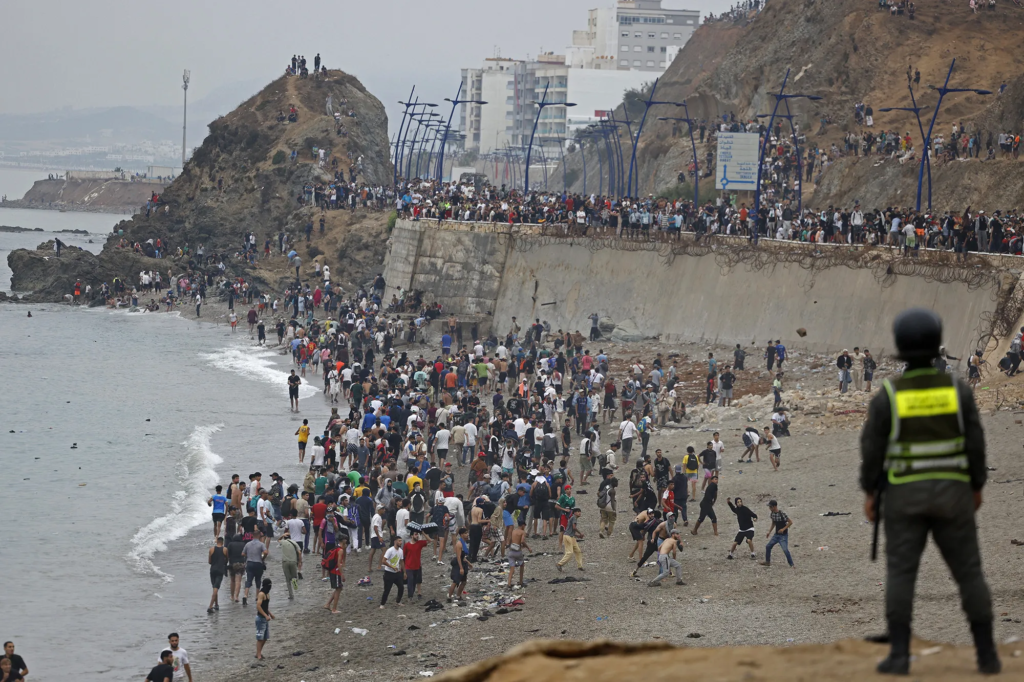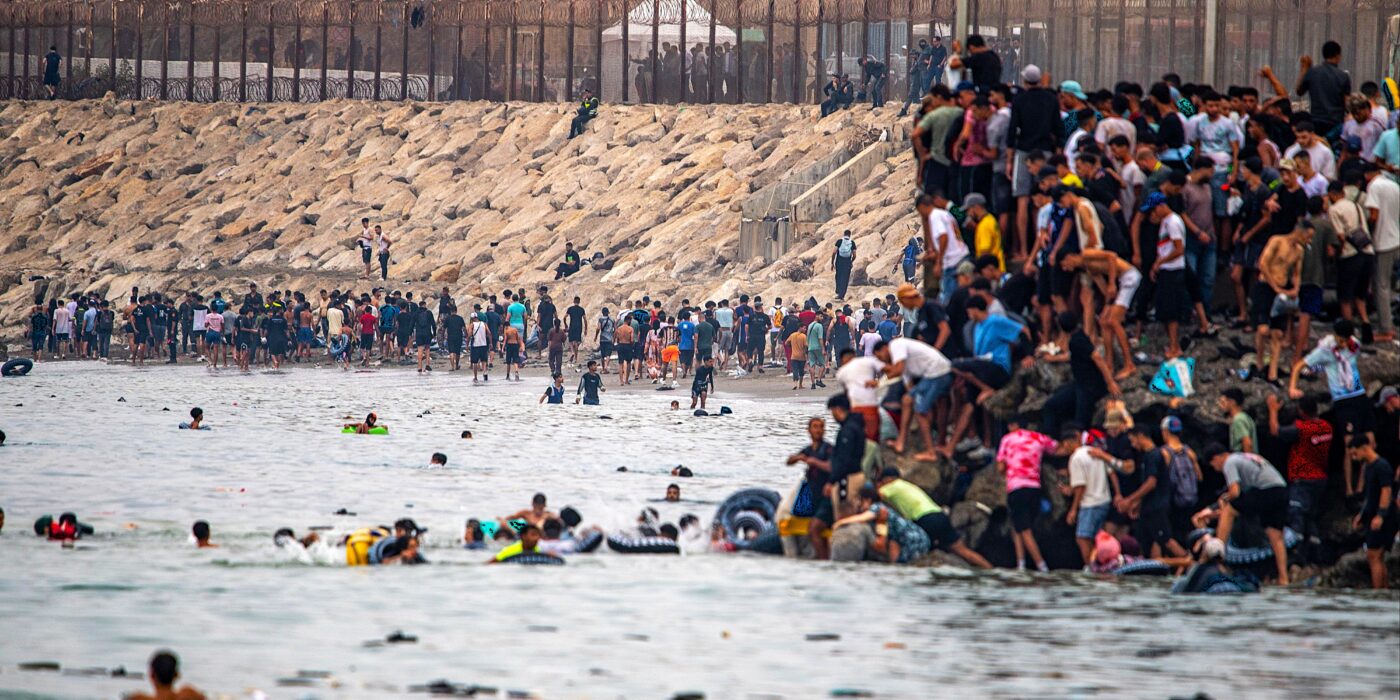
On March 27, 1991, 27,000 Albanians emigrated in a single day from their country to the Italian city of Brindisi, a figure that remained for decades the highest recorded migration driven by economic and social reasons. This record was surpassed on July 30, 2026, when more than 72,000 Moroccans entered, within the space of a few hours, the city of Ceuta, located in northern Morocco and occupied by Spain. This mass entry into Ceuta thus constitutes the largest wave of migration in modern history to occur in a single day and to be linked to economic motives. It was a tragic event because the number of victims exceeded one hundred. Interpretations of this event differ between one reading based on social motivations and another emphasizing geopolitical causes.
An Old Migration and Many Tragedies
Migration from Morocco to Spain by sea, or to Ceuta and Melilla by land, dates back to the late 1980s, when Europe began imposing visas on Moroccans. Initially, this phenomenon mainly involved Moroccans, before Morocco became the principal transit point for irregular migration to Europe between 1990 and 2010. Subsequently, other routes emerged, notably from Mauritania, southern Morocco, and Senegal to the Canary Islands, as well as from the Algerian coast to Egypt toward southern Europe.
Economic and social factors lie behind this migration, and the tragedy of July 30, 2026, can be explained by economic reasons. Young Moroccans face two challenges: the first is the loss of hope of living a dignified life in a state where an oligarchic class is becoming increasingly entrenched without genuine judicial accountability for corruption. The second is finding a way to migrate to Europe, located only a few kilometers from the Moroccan coast, with small boats serving as the principal means.
In recent years, many have relied on this route, and at times on entering Ceuta and Melilla in the hope of subsequently reaching Spain. However, the ease with which more than 72,000 Moroccans were able to enter Ceuta within a few hours requires that other factors be taken into consideration in order to understand what happened. Morocco maintains a high level of border surveillance; police and gendarmerie checkpoints exist between every city, and it is difficult to imagine that 72,000 people could enter Ceuta with such ease, especially since, before reaching the city, there is a quasi-buffer zone comparable to a restricted military area.
This event had serious consequences that will have repercussions for the future of Moroccan-Spanish relations, particularly with regard to mutual trust. The most significant immediate development of this crisis was undoubtedly the statement made by the President of the Spanish Government, Pedro Sánchez, on July 31, 2026, from Ceuta, declaring that “the mass incursion constituted an attack on the unity of the country.” The following day, King Felipe VI called for the protection of the country, a position that was immediately translated into the deployment of additional military reinforcements to the border with Morocco, while urging political parties to avoid political controversy.
This incident will further reinforce Morocco’s image as a source of threat to Spain. Numerous articles have advanced this view, stating: “While Spain is suffering from a historic wave of wildfires, Morocco catches us off guard from the south in Ceuta,” in reference to the massive wildfires that affected Spain throughout July 2026. El País, a newspaper known for its moderate tone, even in its criticism, published an article entitled: “King Mohammed VI Launches His Human Missiles Against Spain.”
A Vital Maritime Corridor
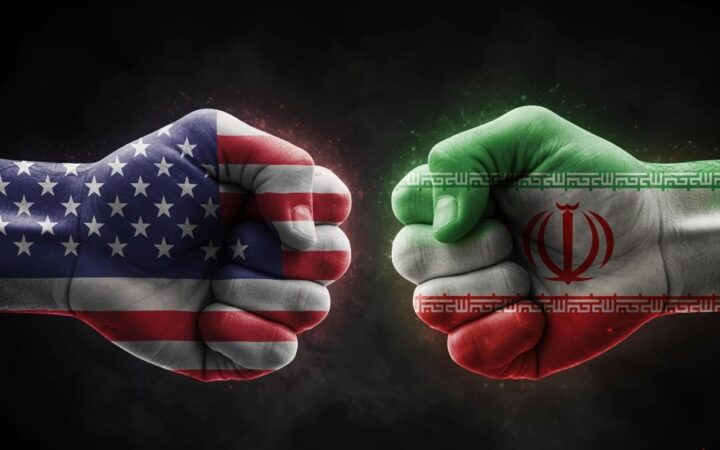
On another level, these events took place in Ceuta, a city overlooking the Strait of Gibraltar, a vital passage for global trade. Any tension arising in its vicinity is enough to generate international concern, adding to the tensions already affecting the Strait of Hormuz, the Bab el-Mandeb Strait, and the Suez Canal, in the current highly sensitive context resulting from the repercussions of the American-Israeli war against Iran.
So far, the global impact of this event lies in the fact that it has provided fuel for the nationalist far right in the West to reinforce its argument that immigration from the South, particularly Muslim immigration, represents a threat to Western civilization. We have thus witnessed a wave of statements from representatives of this political current, led by U.S. President Donald Trump, who stated that a Democratic victory would cause the United States to experience a tragedy similar to that of Ceuta, referring to immigration from Mexico. British far-right politician Nigel Farage declared that those who crossed into Ceuta would eventually reach Britain, while French far-right leader Bardella echoed the same argument. Even businessman Elon Musk, a proponent of the superiority of the Western race, adopted this narrative. Naturally, Santiago Abascal, leader of the far-right Vox party in Spain, found in this crisis an opportunity to gain additional electoral support. All these voices exploited Ceuta to argue that it was the prelude to an Islamic invasion. It appears that the nationalist far right views the tragedy of Ceuta as if it were being led by a new Tariq ibn Ziyad returning to conquer Andalusia once again.
Geopolitical Interpretation
Let us now turn to the geopolitical elements that have been invoked to explain this event at the expense of the social factor. These include the following:
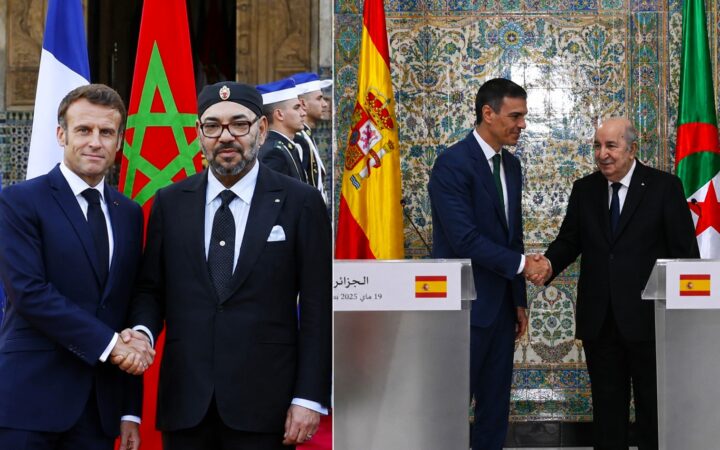
Part of the press in Morocco and Spain claimed that, during the visit of Spanish Prime Minister Pedro Sánchez to Algeria on July 20, 2026, he had secretly agreed with Algerian President Abdelmadjid Tebboune to withdraw Spain’s support for the autonomy plan for Western Sahara. However, the available information indicates that Sánchez merely explained Spain’s position on the issue and refused to allow the final communiqué to contain any reference to the Sahara. For the first time since the 1970s, the Sahara issue was not mentioned in the final communiqué following a visit by a Spanish Prime Minister to Algeria.
At the same time, it was claimed that Spain would support the Nigeria-Algeria gas pipeline project at the expense of the Nigeria-Morocco pipeline. However, neither Spain nor the European Union has shown any interest in either project, and Europeans are not preparing to finance either of them. Furthermore, neither project appears in reports concerning the future of energy in Europe. There is rivalry between Morocco and Algeria over which country will build the first gas pipeline: the one linking Nigeria to Morocco or the one linking Nigeria to Algeria.
In another geopolitical interpretation, some analysts in the Spanish press argued that the objective of the events in Ceuta was to remind the world of the existence of Ceuta and Melilla and to pressure Spain through a repetition of the Green March in the Sahara. On August 3, the newspaper ABC published a provocative article entitled: “Ceuta and the Green March: A New Form of Blackmail in the Debate.” Conversely, some Moroccan analysts argued that the events in Ceuta had placed the issue of Ceuta and Melilla back on the international agenda following the dismantling of the fence separating Spain from Gibraltar after a historic agreement between London and Madrid on the matter. This raises the following question: was it necessary to sacrifice more than 120 Moroccans who drowned so that the world would recognize that Ceuta and Melilla are occupied cities? It would have been sufficient for the Moroccan state to issue a statement calling for the opening of negotiations on the future of the two cities. Is this argument credible when neither royal speeches nor Parliament have mentioned Ceuta and Melilla since 2010? Moreover, the statement issued by the Moroccan Ministry of the Interior on August 2 regarding the events in Ceuta, for the first time in the history of Moroccan government statements, avoided describing Ceuta and Melilla as occupied cities. In May 2021, more than 15,000 Moroccans crossed into Ceuta, and at the time Rabat suggested that the operation was a punishment directed at Spain because of its opposition to the autonomy plan and its refusal to recognize the decision of U.S. President Donald Trump recognizing Morocco’s sovereignty over Western Sahara. This time, however, Rabat has made no reference to any geopolitical element, or even to a simple political factor.
Another narrative circulated in the Spanish and Moroccan press, claiming that the tragedy of Ceuta had been orchestrated by the Israeli Mossad and the United States with the aim of forcing the Prime Minister of Spain to resign. Left-wing activists in both Spain and Morocco relied on statements made by Israel’s ambassador to the United Nations, who had called on the Madrid government to return Ceuta and Melilla to Morocco. This hypothesis would imply facilitating the rise to power of the right, represented by the Popular Party and supported by the far-right Vox party, either in the next elections or in the event of early elections. However, Morocco’s experience with the Popular Party when it governs Spain has been particularly negative: it has been characterized by a lack of dialogue, the predominance of misunderstandings, and an absence of trust. The most notable example remains the Perejil Island crisis in 2002, when José María Aznar was Prime Minister and opted for a military solution rather than dialogue.
Time may, in a few years’ time, reveal the political mystery behind the events in Ceuta in 2026. For the time being, socio-economic factors remain the most widely accepted explanation for what happened. Morocco is experiencing severe social inequalities, unprecedented in its history. The country is plagued by the worst financial and administrative corruption in its history, as documented by specialist international organisations. Morocco is also experiencing the worst crackdown on civil liberties: when Moroccan youth took to the streets in September 2025 as part of the ‘Generation Z’ movement, the regime handed down sentences comparable to those of the Latin American dictatorships of the 1970s and 1980s. Added to this is a state that views emigration as a means of escaping the social crisis, which is lenient towards emigration and encourages it, and which, this time, may have lost control of the situation. Corruption and class inequalities, which result in widespread poverty, are the cause of this, not geopolitical factors.