El Houssine Majdoubi Bahida
The US-Israeli war against Iran is giving rise to numerous geopolitical repercussions and shifts that are affecting international relations and the domestic situation in Middle Eastern countries, particularly the monarchies. These developments now constitute a new kind of pressure, taking the form of a new wave of the ‘Arab Spring’, distinct from the first.
Thus, when the Arab Spring broke out in early 2011 with the fall of Zine El Abidine Ben Ali’s regime in Tunisia, a wave of change spread to countries with republican systems, including Egypt, Libya, Yemen and Syria. In contrast, these monarchies remained immune to change as they were armed with a form of legitimacy blending historical and religious legitimacy, despite lacking political legitimacy based on elected institutions.
Several observers of the Arab world, including Hicham Alaoui, a Moroccan academic researcher at Stanford University, believe that the Arab Spring, which impacted republican regimes, was the first wave. However, the experiment faltered due to the success of the counter-revolution. Hicham Alaoui emphasises that democratisation in the Arab world will take decades, involving the emergence of new forces and demands, and affecting monarchies in one way or another.
In reality, the demand for change has taken root in the minds of the Arab public, even though current circumstances are far from favourable. Just as the Arab Spring took us by surprise in 2011, when political analysts and intelligence reports considered the Arab peoples to be politically inert, we may be caught off guard by a new wave of change. Indeed, much like dormant volcanoes or earthquakes, the momentum of the people can suddenly reawaken. In practical terms, the Arab world has become the epitome of political and social upheaval.
The factor driving change is not necessarily internal popular pressure; it may be an external factor. This is evident from the impact of the US-Israeli war against Iran on the monarchies of the Middle East. So far, these repercussions have been negative for the foreign policy of these regimes and could have domestic consequences for their relations with their populations. How so?
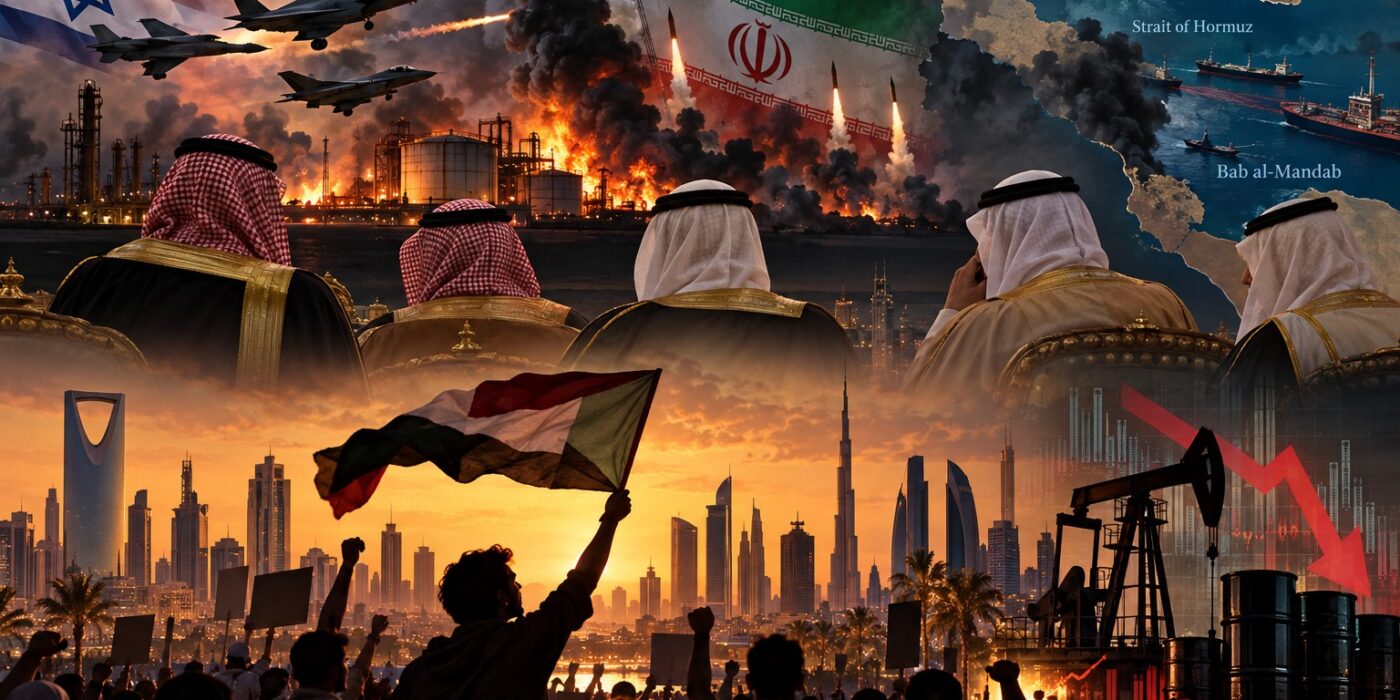
This war has revealed that the United States and Israel cannot defeat Iran militarily. This will prompt Washington to negotiate with Tehran, particularly since the Iranians have succeeded in disrupting maritime traffic in the Strait of Hormuz and the Bab al-Mandab Strait. Significant losses from this war include damage to oil facilities in the Gulf and difficulties exporting oil, particularly to the United Arab Emirates and Saudi Arabia. These two countries led the counter-revolution against the Arab Spring, supporting dictatorships and persecuting journalists and human rights defenders.
In which countries is the so-called ‘Arab Spring’ sentiment evident, which is affecting the monarchies due to the war with Iran?
It has become clear to the peoples of these countries that, despite their vast arsenal of weapons, the ruling monarchies are incapable of defending their national security. These regimes, particularly the centralised House of Saud in Saudi Arabia, are powerless in the face of Iran and the Houthis. These monarchies have justified their existence and prioritised national security over democratic reform in the name of confronting external enemies and defending national unity. Now, faced with their inability to defend the country’s unity, these monarchies are being called into question by public opinion. This strips them of their legitimacy and places them in a position of weakness.
Secondly, these monarchical regimes have relied on the West, particularly the United States, through joint defence agreements. They have used this to justify many of the privileges they have granted to the West at the expense of the national interest. Now, however, Washington is turning its back on these monarchies, Saudi Arabia being the most prominent example. This has led the people of these countries to conclude that these monarchies carry no real weight on the international stage.
Thirdly, at the start of the Arab Spring in 2011, these monarchies bought political stability by providing financial aid to their citizens. The American researcher, Mary Ann Tétreault, argues that the Gulf monarchies were not immune to the Arab Spring, but that money – and repression – saved them. Now these monarchies, led by Saudi Arabia and the United Arab Emirates, are finding it difficult to export oil abroad. This could lead to a decline in financial revenues in the medium term, despite the current rise in oil prices. Consequently, in a country such as Saudi Arabia, the ruling authorities will find themselves in a difficult position when it comes to maintaining social stability.
In general, Frederic Wehrey, an expert at the Carnegie Endowment, believes that this war not only exposes military and economic weaknesses, but also reveals problems with governance and social cohesion within some Gulf states.
The US-Israeli war against Iran has created a new situation in the region that affects all monarchies, foremost among them Saudi Arabia, the UAE and Bahrain, and to a lesser extent the other monarchies. When the people realise that these regimes are incapable of protecting their countries, that is when the spark of thought about reform – and perhaps change – begins to take hold. This is beginning to take shape, albeit in its infancy. It is a new and different chapter of the Arab Spring, affecting the monarchies this time round.
Thus, the war in Iran opens a new chapter of the Arab Spring within the Gulf monarchies and puts them to a difficult geopolitical test.