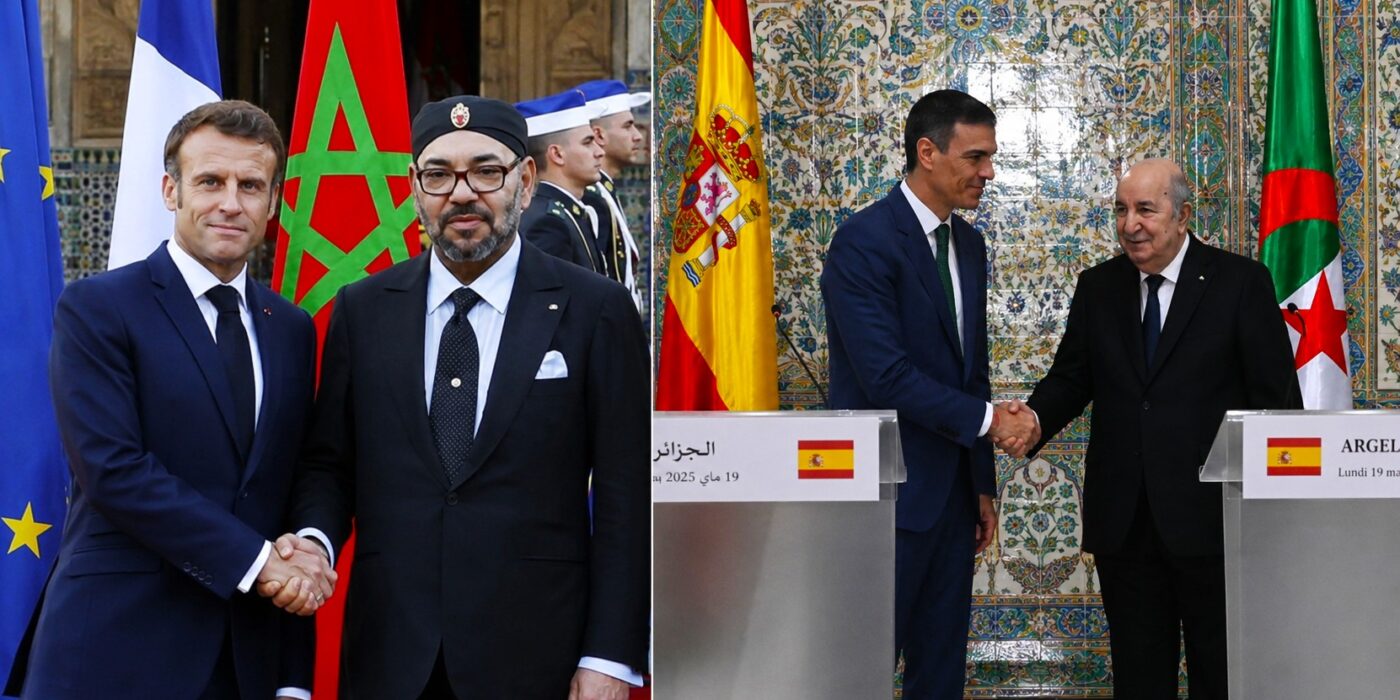
Between 16 and 20 July 2026, Euro-Maghreb relations were marked by three major summits: the Spanish-Algerian Summit, the Moroccan-French Summit, and the German-Algerian Summit. A review of the official statements and final communiqués indicates that the Western Sahara issue has significantly declined in importance in relations among the countries of the western Mediterranean over the past year, and more broadly in Euro-Maghreb relations, despite having long been a central source of tension.
Among the three meetings, the Spanish-Algerian Summit is arguably the most significant, since bilateral relations between the two countries had deteriorated primarily because of the Western Sahara issue. Following the sharp diplomatic crisis triggered in 2022 by Spanish Prime Minister Pedro Sánchez’s endorsement of Morocco’s autonomy proposal as the basis for resolving the conflict—expressed in a letter addressed to King Mohammed VI—relations now appear to be entering a period of renewed stability. At the time, Algeria recalled its ambassador from Madrid and suspended imports from Spain before reversing those measures two years later.
The clearest indication of this rapprochement was Sánchez’s visit to Algeria on 20 July 2026, during which he met President Abdelmadjid Tebboune. The two leaders also agreed to hold a summit between their respective heads of government in October.
Observers of western Mediterranean affairs closely examined the place given to the Western Sahara issue in the final communiqué of the visit, which was primarily devoted to restoring economic cooperation, particularly in the energy sector, with Algeria regaining priority status as a supplier of natural gas to Spain. Although the Western Sahara issue was absent from the public statements, the Spanish news agency Europa Press, in a lengthy report published on Monday of that week, revealed that the subject had indeed been discussed during the talks, although no details were disclosed.
Most analysts specializing in Spanish-Maghreb relations believe that this omission reflected a deliberate political decision by both governments aimed at facilitating the normalization of bilateral relations without reopening the issue that had sparked the 2022 diplomatic crisis. Thus, while the Western Sahara dispute formed the backdrop to the visit, it was deliberately excluded from both the official communiqué and the publicly announced agenda. The newspaper El País noted that Prime Minister Sánchez has not altered his position on the issue and continues to support Morocco’s autonomy proposal as the principal framework for resolving the conflict.
The main message conveyed during the visit regarding Western Sahara was a reaffirmation of support for the United Nations-led process. This stance allows Spain to avoid friction in its relations with Morocco, since the current UN process increasingly favors the autonomy option, in line with the UN Security Council resolution adopted on 31 October 2025 concerning the dispute. At the same time, Spain’s position remains consistent with the European Union’s overall approach to the issue.
Prior to the summit with Spain, Algerian President Abdelmadjid Tebboune visited Germany on 16 July 2026, where he held meetings with senior German officials. The visit concluded with the announcement of a strategic partnership agenda between Algeria and Germany, accompanied by the signing of several agreements and memoranda of understanding aimed at expanding economic and technological cooperation.
Algeria is seeking to deepen its partnership with Germany partly in response to the deterioration of its relations with France in recent years over several issues, including the legacy of French colonialism. As for the Western Sahara issue, it received little attention during the visit, being discussed only as one of several regional matters alongside Libya and the Sahel.
Berlin’s position remains consistent with its longstanding policy of supporting United Nations efforts. Under current circumstances, this effectively means backing the process that gives greater weight to the autonomy option, in accordance with the UN Security Council resolution of 31 October 2025. Germany has traditionally adhered to the UN position and has avoided assuming any direct role in the dispute or mediating between Rabat and Algiers, including during the tenure of German statesman Horst Köhler as the UN Secretary-General’s Personal Envoy for Western Sahara from 2017 to 2019, despite his having served as President of Germany between 2004 and 2010.
On 17 July 2026, Rabat hosted a Moroccan-French summit at the level of the two heads of government. The meeting was described as strategic because it laid the groundwork for broad cooperation across the economic, diplomatic, cultural, and defense sectors, as well as closer coordination on regional and international issues of common interest.
The summit followed several years of strained bilateral relations stemming from multiple disputes, most notably France’s position on Western Sahara and the controversy surrounding the Israeli Pegasus spyware, in which Paris accused Rabat of spying on French ministers and President Emmanuel Macron.
Although Western Sahara did not feature prominently during the summit, Paris reaffirmed the position it had adopted in 2024 in support of Morocco’s autonomy proposal within the framework of Moroccan sovereignty. On 17 July, Le Monde wrote that the summit’s orientation was based on France’s support for the autonomy initiative. Likewise, La Tribune noted on 16 July that the renewed relationship between the two countries had been built upon France’s 2024 policy shift regarding Western Sahara.
According to the summit’s conclusions, France’s position on the Western Sahara dispute remains fully aligned with this new direction in French foreign policy, confirming that support for the autonomy proposal continues to constitute one of the pillars of the Franco-Moroccan strategic partnership, with no indication of any change in the underlying principle. The Moroccan press paid little attention to France’s position, considering it to have become an established fact, while Moroccan ministers likewise refrained from emphasizing the issue, viewing France’s stance as firmly settled.
For decades, the Western Sahara issue has been a major factor shaping Euro-Maghreb relations. Morocco consistently sought to obtain explicit—even if only partial—support for its autonomy proposal at every summit or bilateral meeting. Algeria, by contrast, insisted that joint communiqués reaffirm the principle of self-determination and, on several occasions, resorted to diplomatic and economic retaliatory measures—including recalling ambassadors and reducing economic cooperation—as occurred in its relations with both France and Spain over the past three years.
However, following the adoption of the UN Security Council resolution of 31 October 2025, which gave greater prominence to the autonomy option, and the United States’ reaffirmation of its support for this approach, several European countries have aligned themselves with this evolving position. This has contributed to diminishing the influence of the Western Sahara dispute on Euro-Maghreb relations.
The three summits held over the past two weeks appear to confirm this trend. They reflect a clear willingness to deliberately omit the issue from official statements and communiqués in order to avoid reigniting tensions among the parties involved, while prioritizing economic and strategic cooperation over political disagreements, whose management remains under the auspices of the United Nations.