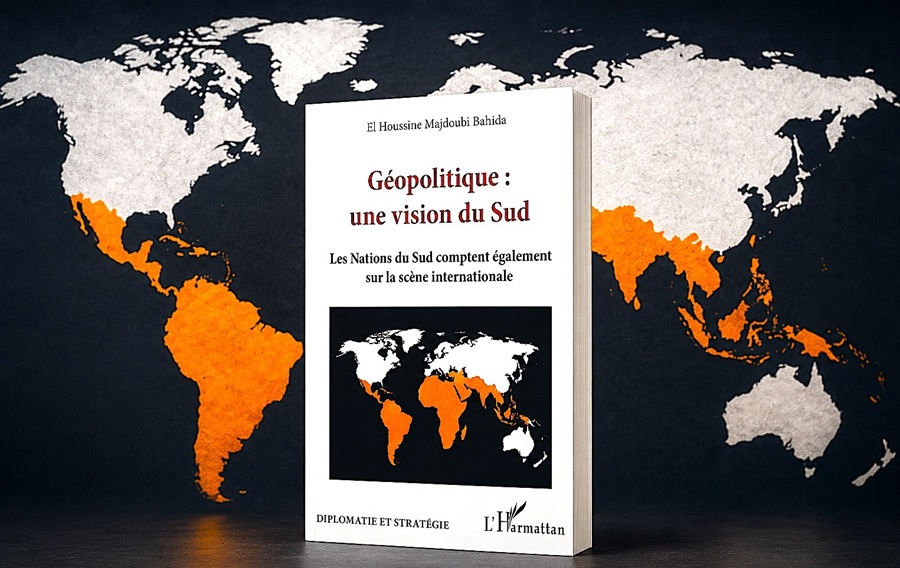
Geopolitics: A Vision from the South (Éditions L’Harmattan) is a book by journalist El Houssine Majdoubi Bahida. It presents a geopolitical perspective from the Nations of the South, addressing concerns specific to this vast, diverse region. Examining major events of the past decade, it considers how these have contributed to the awakening of the Nations of the South, as well as the challenges facing its nations, whilst reflecting on the future of relations between France and the Nations of the South.
The book begins with a call for researchers to use the term ‘Nations of the South’ instead of Western labels such as ‘Third World’ or ‘Global South’. Bahida argues that these terms were coined in economic and political contexts linked to the West’s perception of others. He presents this invitation as part of a review of the numerous terms that the West has used to describe the Nations of the South throughout history. While some of these terms may be considered scientific and objective, others stem from an orientalist approach inspired by a culture of supremacy and domination.
In the first part, the author focuses on the theoretical concepts that help explain changes to the global geopolitical landscape. In particular, he highlights the gradual shift of economic power from the West to the East as part of a great civilisation cycle, drawing on the theories of Ibn Khaldun, Toynbee and Spengler. He argues that the mastery of knowledge and the technological revolution are the main drivers of current change.
The author also examines the new Cold War between the United States and China, and its impact on the global alliance landscape, forcing nations of the South to reconsider their alignment. The book then reviews the various geopolitical concepts currently adopted by major powers such as the United States, Russia, China and the European Union.
One of the book’s most important chapters discusses the awakening of the Nations of the South and how they have developed a new sense of self-awareness following major global events of the last two decades. Some of these events are linked to the sociological evolution of these societies, most notably the emergence of an elite with a shared vision who are ready to play their historic role in promoting progress in their countries.
Other events have prompted the Nations of the South to consider placing greater emphasis on self-sufficiency. The pandemic, the war in Ukraine and the conflict in Palestine have led them to question whether we are returning to a ‘law of the jungle’ scenario, where the strongest rule, and to consider whether an alliance of the Nations of the South might be the solution.
In the second part of the book, the author highlights the countries which, in his view, symbolise the resurgence of the South over the past decade. He focuses in particular on the role of Turkey, which he describes as the ‘China of the Mediterranean’, and on its determination to curb French influence. He also examines how Morocco is attempting to reclaim its historic role in West Africa and how South Africa is seeking to become the voice of the African continent. He then discusses the particularly active roles played by small emerging countries, such as the United Arab Emirates and Qatar, in international relations, notably in the management and mediation of major conflicts.
Among the signs of the South’s resurgence, the book discusses the development of the defence industry in countries such as Turkey, Iran and Pakistan, as well as how this trend is beginning to reshape regional balances in several parts of the South, particularly in conflict-affected regions. In particular, the author cites the example of the use of Iranian and Turkish drones in the Russia–Ukraine war, where, for the first time in centuries, weapons manufactured in the South are being used in a war taking place in the North.
The book also addresses some of the challenges facing the South in its journey towards geopolitical re-emergence, notably the burden of loans and debt, which can hinder investment. It also discusses what the author sees as the obstacle posed by limited access to nuclear energy for electricity generation, as if the West and the major powers had arrogated to themselves the exclusive right to use this technology.
According to the author, the West appears to operate on the assumption of a ‘clash of civilisations’ in the field of nuclear energy, due in particular to its insistence on preventing certain countries of the Nations of the South from making full use of it for civilian purposes. This issue thus constitutes one of the major challenges to the energy and technological sovereignty of the Nations of the South.
The book then examines the complex relationship between the South and the Western countries that once colonised it, at a time when certain states and civil society activists are beginning to demand reparations for the harm caused during the colonial period. In particular, it shows how countries such as Algeria are focusing their claims on France in what the author calls the ‘war of memory’.
A chapter is also devoted to the relationship between France and the nations of the South. The author explores the possibility of France moving from a period of exercising tutelage over certain countries – particularly in Africa – to a new phase based on coordination and cooperation on international issues. This shift would be linked to the fact that Paris no longer has the same capacity as before to take decisions with international implications on its own.
The book concludes with theoretical proposals concerning the geopolitical challenges that the Nations of the South will face in the future. In particular, the author emphasises what he calls ‘the geopolitics of integration and convergence’, presented as a possible way of strengthening cooperation, autonomy and the international influence of the Nations of the South.
El Houssine Majdoubi Bahida is a journalist and writer of Moroccan origin, based in the United Kingdom. He holds a PhD in Communication Studies and works for the London-based newspaper Alquds Arabia (alquds.co.uk), where he covers international issues, particularly relations between the European Union and the Maghreb. His daily observation of current affairs, informed by both a journalistic approach and academic analysis, has led him to publish several books on international relations, including this one, which focuses on the aspirations of the nations of the South.
Publisher : Editions L’Harmattan
- Publication date : 23 April 2026
- Language : French
- Print length : 198 pages
- ISBN-10 : 2336613794
- ISBN-13 : 978-2336613796